
| Problem | Solution |
|---|---|
| Migrations applied by hand, approvals scattered over tickets and chat, no way back from a bad change | Database Change Management |
| Credentials shared across SQL clients, no control over who can query what, standing access that never expires | Database Access Control |
| Can’t show the auditor who changed or accessed what, and when | Database Compliance |


Database Change Management
Governs how schema and data changes reach your databases, eliminating the need for engineers to make direct changes against them. Every change becomes a reviewed, approved, and recorded rollout. Learn more in Database CI/CD.- Automated SQL review: Lint every proposed change against 100+ review rules before a human ever looks at it.
- Risk-based approval flows: Route changes through multi-step approvals scaled to their risk and target environment.
- UI-driven or GitOps workflow: Manage changes from the console, or entirely as code via GitOps with GitHub, GitLab, Bitbucket, and Azure DevOps.
- Fleet-wide batch changes: Apply one change across a collection of databases in a single coordinated workflow.
- 1-click rollback: Recover instantly from unintended UPDATE or DELETE statements with data rollback.
Database Access Control
Governs who can query what data, replacing disparate SQL clients and shared credentials. Explore the full capabilities in the SQL Editor section.- Centralized permissions: Grant query and export access by role, not by handing out database passwords — one place to manage who can see what.
- Just-in-time access: Let users request time-bound access that routes through the same risk-based approvals and expires automatically instead of holding standing privileges.
- Dynamic data masking: Mask sensitive columns in query results, so PII stays protected even for users who are allowed to query the table.
Database Compliance
Change management and access control only count if you can prove they happened. Bytebase records the evidence as a byproduct of the workflow — no separate bookkeeping.- Complete audit log: Every change, approval, permission grant, and query is captured in the audit log — filterable, streamable to external monitoring systems, and exportable as evidence for SOC 2, GDPR, and HIPAA reviews.
- Data classification: Classify columns by sensitivity and drive masking and access policies from the classification.
- Policy as code: Codify approval flows, access and masking policies, and SQL review rules with the Terraform provider, so the controls themselves are version-controlled and consistent across environments.

Try Bytebase
Quick Start
Five steps from an empty workspace to a reviewed schema change and your first query. Works on Cloud or Docker.
Bytebase Cloud
Sign up for a free workspace and start in seconds.
Self-host
Deploy with Docker on your own infrastructure.
Compare
Schema Migration Tools
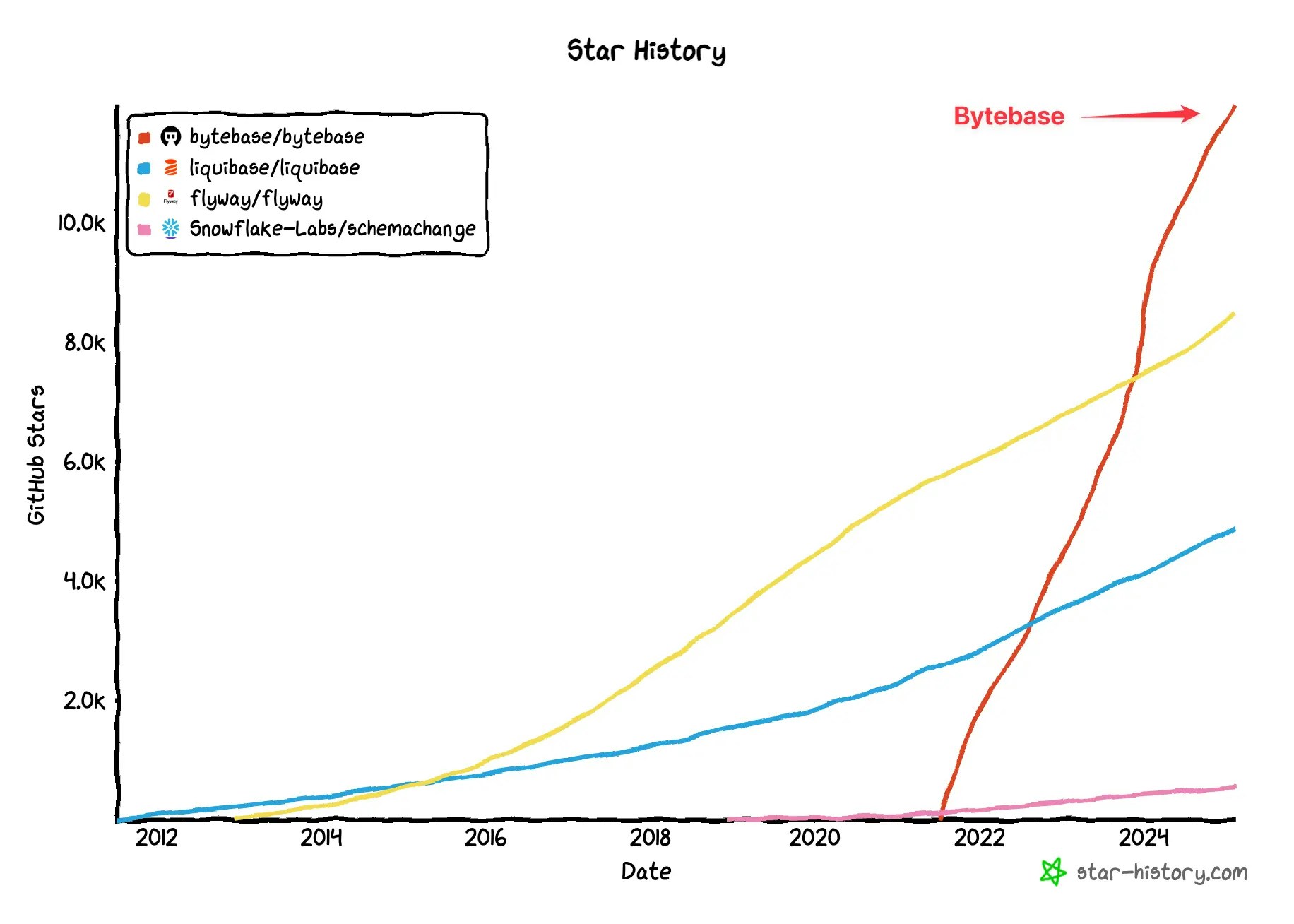
While Liquibase and Flyway are powerful command-line migration tools (think Git), Bytebase provides the complete platform experience (think GitHub/GitLab). It wraps these migration capabilities in a collaborative interface with approval workflows, audit trails, and enterprise controls. As the fastest-growing open source solution in this space, Bytebase has become the top choice for teams seeking a unified database governance platform.